Most people plan a vision correction trip to Korea in the wrong order. They book the flights, book the hotel, sketch out an itinerary — and only then start reading about the surgery itself.
By that point, two things have usually gone wrong.
They’re still wearing contact lenses, which means the pre-surgery measurements won’t be accurate. And they’ve built an itinerary full of things they won’t be allowed to do afterward — the jjimjilbang, the water park, the Han River swim, the hike up Bukhansan.
I live in Seoul and plan trips here for a living. This is the timeline I wish every visitor had before they booked anything.
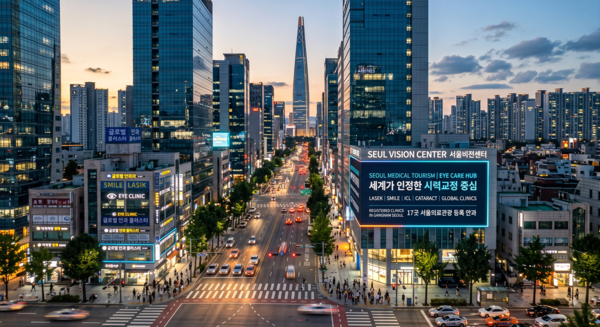
The one thing that can cancel your surgery before you even land
Contact lenses reshape your cornea. Not permanently, but enough to matter.
Wearing them reduces the oxygen reaching the cornea, which can cause mild swelling. A swollen cornea measures differently than a rested one — and every part of your surgical plan is built on those measurements. If they’re off, your prescription correction can be off too.
So clinics require you to stop wearing lenses before the exam. Typical guidance:
| Lens type | Stop wearing before exam |
|---|---|
| Soft lenses | At least 2 weeks |
| Toric / astigmatism lenses | At least 2 weeks, often longer |
| RGP / hard lenses | 3 weeks or more |
| Ortho-K (overnight reshaping lenses) | Considerably longer — ask your clinic |
This is the single most common reason a vision correction trip falls apart. People arrive, get examined, and are told the readings aren’t stable. Best case, they wait a few days and re-test. Worst case, they fly home without surgery.
What to do: the moment you start seriously considering surgery, switch to glasses. If you don’t own a current pair, order one now — you’ll be wearing them for weeks, plus the flight, plus the days right after surgery. The exact lens-free period depends on your prescription and lens type, so it needs to be confirmed with the clinic before you book flights.
How many days do you actually need in Seoul?
The surgery itself is fast. The schedule around it is what people underestimate.
A typical sequence:
- Comprehensive examination. At a thorough clinic this takes around two hours, not twenty minutes. More on why that matters below.
- Consultation and surgical plan. Your results determine which procedure is appropriate for your eyes. This is not a menu you order from.
- Surgery. Same day or the next, depending on the clinic and your results.
- Next-day check. Standard practice after laser vision correction.
- Further follow-ups over the following weeks.
Some Seoul clinics offer a same-day option — examination in the morning, surgery in the afternoon — specifically designed for patients traveling from abroad. It’s worth asking about, because it can cut a day or two off your trip.
Two scheduling details that catch travelers out:
Most clinics are closed on Sundays and public holidays, with Saturday hours ending early afternoon. If you land Saturday evening, your first possible exam is Monday.
Korean holidays can close clinics for several days. Seollal (Lunar New Year) and Chuseok are multi-day national holidays, and the dates shift each year because they follow the lunar calendar. Check them before you pick your dates.
As a planning rule: build your flights around the clinic’s schedule, not the other way around. Confirm the minimum stay, whether the next-day exam is mandatory, and how far ahead they need your booking — before anything is non-refundable.
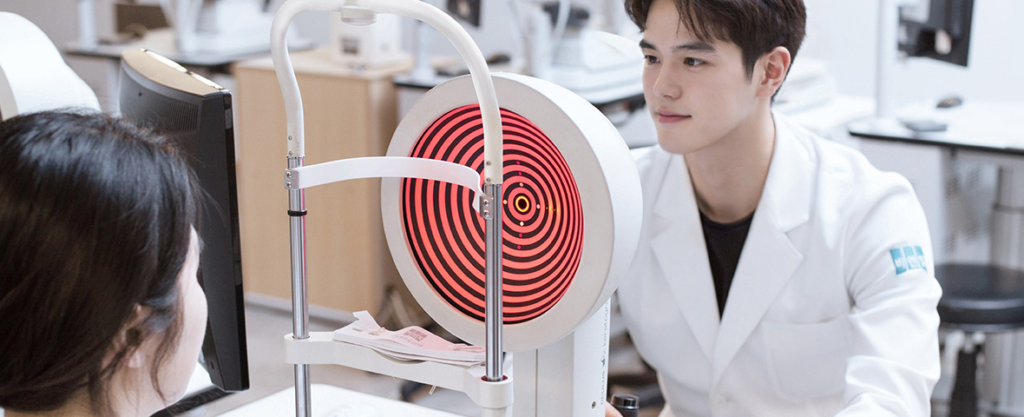
How to choose a clinic in Seoul
Seoul has a lot of vision correction clinics, and from the outside they look similar — modern interiors, English websites, competitive prices. The differences that actually matter aren’t visible on a homepage.
Here’s what to ask about.
How long is the pre-surgery examination? This is the clearest signal of how a clinic operates. A thorough workup runs around two hours and covers dozens of separate measurements — corneal topography and thickness across the whole surface, tear film quality, pupil size in low light, retinal health, intraocular pressure. A twenty-minute screening cannot produce a genuinely customized surgical plan. Ask how long it takes and how many tests are included.
Do they include genetic screening for corneal dystrophy? There’s a hereditary corneal condition (granular corneal dystrophy, linked to the TGFBI gene) that laser surgery can dramatically accelerate. Carriers often have no symptoms and no family history they know of. A DNA test — the Avellino test is the common one — screens for it before surgery. Not every clinic includes it. Ask.
How many laser platforms do they have? A clinic with one laser can only offer what that laser does, which means the recommendation you get may be shaped by their equipment rather than your eyes. Clinics running multiple platforms can genuinely match the procedure to your corneal thickness and prescription.
What’s the clinic’s track record, and how many surgeons? Years in operation, cumulative case volume, and the number of ophthalmologists on staff. Korea’s first-generation vision correction centers opened in the mid-1990s and some have now treated hundreds of thousands of eyes. Depth of staff also matters for continuity if something needs attention.
What language support actually exists? An English website is not the same as an English-speaking coordinator who manages your case from first inquiry to final follow-up. Ask whether there’s a dedicated international patient manager and which languages the clinic handles.
What happens after you fly home? Ask about remote follow-up, whether they’ll provide your surgical records in English, and what the revision policy is if you need an enhancement later. Get the answer before surgery, not after.
Are they willing to tell you no? This is the most underrated signal. A good clinic turns away patients whose corneas are too thin, whose prescriptions are unstable, or whose screening flags a risk — and offers a different procedure or none at all. A clinic that clears everyone is telling you something.
What vision correction costs in Korea
Pricing varies by clinic tier and by procedure. As a reference point, these are representative prices at an established Seoul center, for both eyes:
| Procedure | Price (KRW) | Approx. USD |
|---|---|---|
| LASIK / LASEK | from 2,200,000 | ~$1,620 |
| SMILE | from 3,000,000 | ~$2,210 |
| Customized (topography-guided) laser | from 3,600,000 | ~$2,650 |
| SMILE Pro | from 4,700,000 | ~$3,460 |
| ICL (implantable lens) | from 5,600,000 | ~$4,120 |
| Toric ICL (with astigmatism correction) | from 6,700,000 | ~$4,930 |
USD converted at roughly ₩1,358 to the dollar (September 2026). Budget clinics price below this; premium centers above. Some clinics offer discounts for same-day surgery. Always confirm current pricing directly.
Roughly, how the procedures differ:
- LASEK / PRK reshapes the corneal surface with no flap. Often the option when corneas are too thin for LASIK. Recovery is slower and less comfortable in the first few days.
- LASIK creates a corneal flap, lifts it, reshapes underneath, and replaces it. Fast visual recovery, decades of track record.
- SMILE removes a small lens-shaped piece of tissue through a tiny incision — no flap. Generally associated with less dry eye and no flap-related risk.
- SMILE Pro is the newer generation of SMILE on updated laser hardware, with shorter laser time.
- ICL / PIOL implants a lens inside the eye rather than reshaping the cornea. The route for very high prescriptions or corneas too thin for laser. Toric versions also correct astigmatism.
Which one is right for you isn’t a preference — it’s determined by your corneal thickness, prescription, dry eye, and pupil size. Anyone quoting you a procedure before examining your eyes is guessing.
What you can’t do in Seoul after surgery
This is the part travel guides never cover, and it’s the part that wrecks itineraries.
Typical post-operative restrictions after laser vision correction:
| Activity | Typical wait |
|---|---|
| Flying | ~24 hours (bring lubricating drops — cabin air is very dry) |
| Driving | 24–48 hours |
| Light exercise | 3–4 days |
| Eye makeup | ~1 week |
| Swimming pools, water parks | ~1 month |
| Saunas, jjimjilbang, hot springs | ~1 month |
| Contact sports | ~1 month |
| Full visual stabilization | 2–4 weeks |
These are general ranges. Your surgeon’s instructions override anything here, and they vary by procedure — LASEK recovery is slower than SMILE, for example.
Now look at that list against a normal Seoul itinerary.
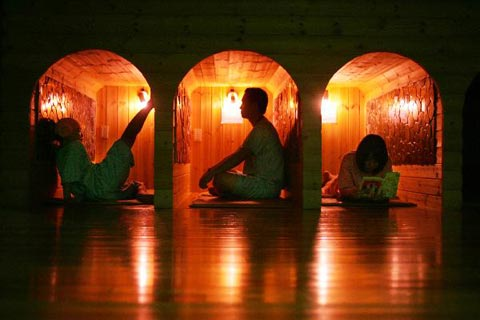
Jjimjilbang is out for a month. For a lot of first-time visitors this is a top-three experience, and the heat, steam, and shared water are exactly the conditions clinics warn about.
Swimming is out. That covers Hangang outdoor pools in summer, Caribbean Bay, hotel pools, and any water park.
Bright sun needs managing. Bring proper UV sunglasses. Palace courtyards, Bukchon, the Han River parks, and Namsan are all wide open and bright.
Dusty, windy conditions are worth avoiding early on — long hikes on exposed trails, construction-heavy streets in spring.
Screens get tiring faster in the first days. If your plan was to sit in cafés editing photos, expect to want breaks.
None of this makes a Seoul trip bad. It just means the order matters.
A 7-day Seoul trip built around surgery
Here’s how I’d sequence it. Adjust once your clinic confirms their required schedule.
Before you fly — 3 weeks out Glasses only. No contacts. Exam booked. Prescription history sent ahead if the clinic asks for it.
Day 1 — Arrive Land, check in, rest. Nothing demanding. If you arrive Saturday evening or Sunday, remember most clinics are closed.
Day 2 — Examination and surgery Around two hours of testing, consultation, then surgery in the afternoon if you’re cleared and the clinic offers same-day. Go straight back to your accommodation afterward. Plan nothing else. Have food already in the room.
Day 3 — Follow-up, then a gentle day Morning check at the clinic. Afterward, low-stimulation and mostly indoor: a department store like The Hyundai Seoul, Starfield Library at COEX, a quiet café in Seochon. Sunglasses on outdoors.
Day 4 — Easy walking, shaded Ikseon-dong’s alleys, Cheonggyecheon stream, a hanok café. Short distances, plenty of sitting.
Day 5 — Palaces and markets Gyeongbokgung or Changdeokgung, then Gwangjang Market. Both are bright and open — sunglasses matter. Note that palaces close on either Mondays or Tuesdays depending on the site, and Changdeokgung’s Secret Garden limits visitors to 100 per session, so book ahead.
Day 6 — Neighborhoods Seongsu-dong, Seoul Forest, or a Han River park walk. Still no swimming.
Day 7 — Shopping and fly out Olive Young, Myeongdong, or Hongdae. Lubricating drops in your carry-on, not your checked bag.
What’s not on this list: jjimjilbang, water parks, Hangang pools, long exposed hikes, contact sports. Save those for the next trip — which is a genuinely good reason to come back in autumn.
The best time of year to come
If your dates are flexible, this matters more than usual for a surgery trip.
Autumn (September–November) is the best window. Air is clear, temperatures are mild, and there’s no swimming or sauna season you’d be missing. Foliage season also gives you plenty of low-intensity things to do.
Spring (March–May) has an air quality problem. Yellow dust and fine particulate season overlaps with pollen, and both are irritating to healing eyes. Cherry blossoms are wonderful and the crowds are enormous — do that trip in a year when you’re not recovering.
Summer (June–August) is the worst fit. Hot, humid, and every appealing summer activity in Korea — Hangang pools, water parks, beaches — is off-limits for a month after surgery.
Winter (December–February) works, with caveats. Dry indoor heating is hard on eyes that are already dry post-surgery, so run a humidifier and use your drops. Ski trips are out for a while.
Flying home, and aftercare from a different country
This is the concern that stops most people from having surgery abroad, so it’s worth addressing directly rather than glossing over.
Flying is generally fine after about 24 hours. The real issue is cabin air, which is extremely dry. Keep lubricating drops in your carry-on and use them more often than feels necessary.
Before you leave Korea, collect your records. Your surgical report, pre- and post-operative measurements, and the exact name of the procedure performed — in English. Ask what specific complications to watch for and what would count as urgent.
Line up local follow-up before you fly out. An optometrist or ophthalmologist at home can check your vision and eye pressure at the standard intervals. Ask your Korean clinic which checks they want done, when, and whether they’ll review results remotely.
Understand the revision policy in advance. A small percentage of patients need an enhancement procedure later. Ask what it costs, whether it’s included, and how long any guarantee lasts. Get it in writing before surgery.
A clinic that handles international patients well will have clear answers to all of this ready.
Frequently asked questions
How long do I need to stay in Korea for LASIK? Plan for a stay that covers your examination, the surgery, and at least one follow-up exam the next day. Some Seoul clinics offer same-day examination and surgery for international patients, which can shorten the trip. Confirm the exact requirement with your clinic before booking flights, since it varies by procedure.
How long before LASIK do I have to stop wearing contacts? Generally at least two weeks for soft lenses and three weeks or more for hard RGP lenses. Contact lenses can cause corneal swelling that makes pre-surgery measurements inaccurate. Confirm the exact period with your clinic.
Can I go to a jjimjilbang after laser eye surgery? Not for about a month. Saunas and hot, humid, shared-water environments are typically restricted for around four weeks after surgery.
Can I fly after LASIK? Usually after about 24 hours. Cabin air is very dry, so bring lubricating eye drops in your carry-on.
How much does LASIK cost in Korea? At an established Seoul center, pricing typically starts around ₩2,200,000 (approx. $1,620) for LASIK or LASEK and runs to around ₩6,700,000 (approx. $4,930) for Toric ICL. Budget clinics price lower and premium centers higher.
Is it safe to get vision correction surgery abroad? The main considerations are how thoroughly the clinic screens you, the surgeon’s experience, and your aftercare plan once you fly home. Ask about examination depth, genetic screening for corneal dystrophy, revision policy, and remote follow-up before you book.
Which clinic should I go to? That depends on your prescription, corneal thickness, budget, and travel dates — which is why a blanket recommendation isn’t useful. See below.
Let me help you plan it
The sequencing is the hard part of a vision correction trip. Clinic hours and holiday closures, how many days you actually need, what you can and can’t do in each recovery window, and how to fill the days when you need to take it easy.
I plan Seoul trips for visitors, and I work with vision correction centers here. Tell me your travel dates, your prescription situation, and what you want to see — and I’ll put together a schedule that fits around your surgery, recommend the clinic that suits your case, and help arrange the appointment.
No cost, and no obligation to book anything.
[Plan my Seoul trip → /plan-your-trip/]
Medical information in this article is general and drawn from published sources. It is not medical advice. Your surgeon’s instructions always take priority. Procedure suitability, recovery timelines, and restrictions vary by individual.
Last updated: September 2026