Most people arrive at this decision the wrong way round. They read about the procedures, decide they want SMILE because it sounds the most advanced, and then get told at the clinic that they’re not a candidate for it.
You don’t choose your procedure. Your corneas do.
Corneal thickness, prescription strength, dry eye, pupil size in low light, corneal shape — these rule options in and out before preference gets a vote. What’s useful to understand beforehand is why a surgeon might steer you one way, so the consultation makes sense instead of feeling like a sales pitch.
Here’s the plain-English version.
Planning the trip around it? Start with Planning a Trip to Korea for LASIK — the contact-lens rule alone catches most people out.
The short version
| Best known for | Typically suits | |
|---|---|---|
| LASEK / PRK | No flap, works on thinner corneas | Thin corneas, contact-sport athletes |
| LASIK | Fast recovery, decades of track record | Moderate prescriptions, healthy corneal thickness |
| SMILE | No flap, less dry eye | Dry-eye-prone, screen-heavy work |
| SMILE Pro | Newer generation of SMILE, shorter laser time | Same as SMILE, with faster treatment |
| ICL | Doesn’t remove corneal tissue; reversible | High prescriptions, corneas too thin for laser |
LASEK / PRK — the surface option
What it is: the outer layer of the cornea (the epithelium) is moved aside, the laser reshapes the surface underneath, and the epithelium regrows over the following days. No flap is created at all.
Why a surgeon might recommend it: it removes less corneal tissue than LASIK, so it stays available when the cornea is too thin for a flap. And because there’s no flap, there’s nothing that can be dislodged later — which matters for boxing, martial arts, rugby, or a job with impact risk.
The trade-off is the recovery. The first few days are genuinely uncomfortable while the surface heals, and useful vision takes several days rather than overnight. Full stabilisation can run four weeks or more.
For a travel schedule, this is the one that fits worst. If you’re in Korea for ten days and LASEK is what you qualify for, expect to spend the first three or four of them taking it very easy.
LASIK — the established one
What it is: a thin flap is created in the cornea, lifted, the tissue underneath is reshaped by laser, and the flap is laid back down. It seals without stitches.
Why it’s still the default at most clinics: the recovery is fast — most people see well the next day — it’s been performed for decades, and it handles a wide range of prescriptions including farsightedness.
The trade-offs: creating the flap cuts more corneal nerves than the flapless methods, which is one reason dry eye is more commonly reported in the months afterward. And the flap, while it heals firmly, is a structure that theoretically can be displaced by significant trauma. In practice this is rare, but it’s why surgeons steer contact-sport athletes elsewhere.
Also the most affordable option at most Korean clinics.
SMILE — flapless, through a small incision
What it is: the laser shapes a small lens-shaped piece of tissue (a lenticule) inside the cornea, and the surgeon removes it through an incision of a few millimetres. No flap.
Why it appeals: because the incision is small, fewer corneal nerves are cut, and SMILE is generally associated with less post-operative dry eye than LASIK. There’s no flap, so no flap-related risk. The cornea also retains more of its structural integrity.
Who it tends to suit: people who already have dry eyes, who spend all day on screens, or who wear contacts uncomfortably — which is a large share of the people considering surgery in the first place.
The trade-offs: the range it treats is narrower than LASIK. Historically SMILE has been used mainly for nearsightedness and astigmatism, and very high prescriptions can fall outside it. Enhancement procedures, if ever needed, are also handled differently than with a LASIK flap.
SMILE Pro — the newer generation
What it is: SMILE performed on updated laser hardware. The laser portion is substantially faster — around ten seconds per eye — and the newer platform adds automated eye-alignment features that compensate for how the eye rotates when you lie down.
What it changes in practice: the procedure itself is quicker, which for a patient mostly means less time holding still. The surgical principle is the same as SMILE.
Is it worth the price difference? At Korean clinics SMILE Pro typically runs meaningfully more than standard SMILE. Whether the newer platform is worth it is a reasonable question to put directly to your surgeon — ask what specifically it changes for your eyes, not in general. A good answer will reference your measurements. A vague answer about it being “the latest technology” tells you something too.
ICL — a lens inside the eye
What it is: rather than reshaping the cornea at all, a soft implantable lens is placed inside the eye, behind the iris and in front of the natural lens. Sometimes called a phakic IOL or PIOL.
Why it exists: laser procedures work by removing corneal tissue, and there’s a limit to how much can safely be removed. Very high prescriptions, or thin corneas, can hit that limit. ICL sidesteps it entirely — nothing is removed.
Its two real advantages: it handles much higher prescriptions than laser methods, and it’s reversible — the lens can be removed or exchanged, which no laser procedure can offer.
The trade-offs: it’s intraocular surgery rather than surface surgery, so the risk profile is different — intraocular pressure needs monitoring, and there’s a small long-term consideration around the natural lens. It’s also the most expensive option by a clear margin.
Toric ICL is the version that also corrects astigmatism.
What actually decides it
When a clinic runs a proper workup — and it should take around two hours, not twenty minutes — these are the measurements doing the deciding:
Corneal thickness. Every laser procedure removes tissue. There’s a floor below which surgeons won’t go, and how much needs removing depends on how strong your prescription is. Thin cornea plus high prescription is the classic route to ICL.
Prescription strength. Higher prescriptions require removing more tissue, which interacts with the point above. Beyond a certain point, laser stops being the sensible answer.
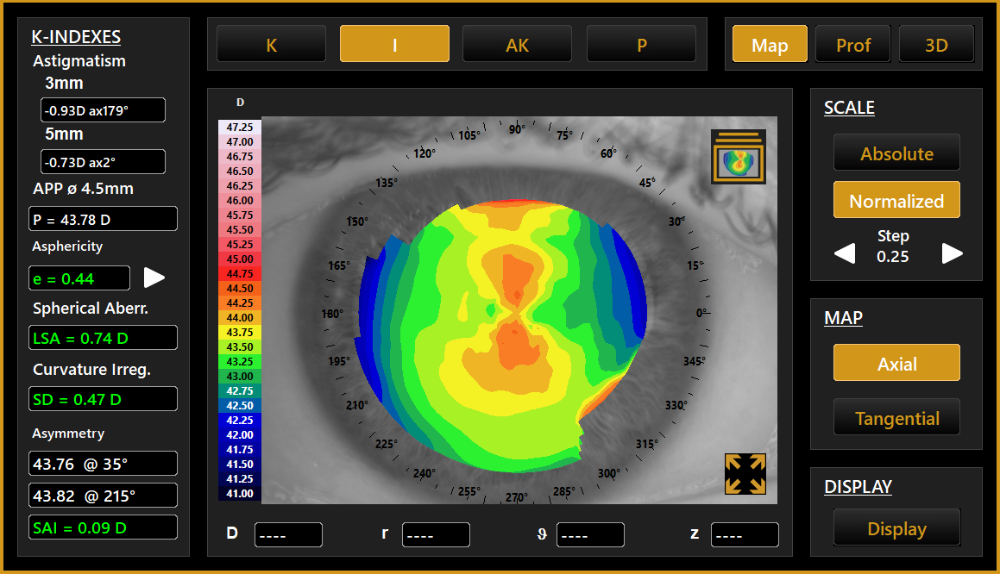
Corneal shape. Screening looks for irregularities and signs of keratoconus, a condition in which the cornea progressively thins and bulges. Laser surgery on a cornea heading that way makes things worse, so this screening is not optional.
Genetic screening. There’s a hereditary condition — granular corneal dystrophy, linked to the TGFBI gene — that laser surgery can dramatically accelerate. Carriers often have no symptoms and no known family history. A DNA test screens for it. Not every clinic includes this. It’s worth asking whether yours does.
Tear film quality. If you already have significant dry eye, that shapes the recommendation toward flapless options and changes what you’re told to expect afterward.
Pupil size in dim light. Large pupils are associated with more night-time glare and halos after surgery, which affects both the choice of procedure and how the treatment zone is planned.
Your life. Contact sports, a dusty work environment, or a job that’s twelve hours of screens all legitimately change the recommendation.
This is why a surgeon who names a procedure before examining you is guessing — and why an exam that takes twenty minutes can’t be producing a genuinely customised plan.
What it costs in Korea
Representative pricing at an established Seoul vision-correction centre, for both eyes:
| Procedure | Price (KRW) | Approx. USD |
|---|---|---|
| LASIK / LASEK | from 2,200,000 | ~$1,620 |
| SMILE | from 3,000,000 | ~$2,210 |
| Customised (topography-guided) laser | from 3,600,000 | ~$2,650 |
| SMILE Pro | from 4,700,000 | ~$3,460 |
| ICL | from 5,600,000 | ~$4,120 |
| Toric ICL (with astigmatism correction) | from 6,700,000 | ~$4,930 |
Converted at roughly ₩1,358 to the dollar, September 2026. Budget clinics price below this and premium centres above. Some clinics discount for same-day surgery. Always confirm current pricing directly.
How that compares depends entirely on where you’re from. For visitors from the US, the UK, Australia or Singapore, Korean pricing is typically well below what the same procedure costs at home — often by half or more. For visitors from India or much of Southeast Asia, where laser correction is already inexpensive, the gap narrows or disappears. Worth checking your own market before treating price as the reason to travel.
Recovery, compared
| Useful vision | Full stabilisation | Comfort in first days | |
|---|---|---|---|
| LASEK / PRK | Several days | Up to ~4 weeks | Hardest |
| LASIK | Usually next day | 1–2 weeks | Easy |
| SMILE / SMILE Pro | Usually next day | 1–2 weeks | Easy |
| ICL | Usually next day | 1–2 weeks | Easy |
General ranges. Individual recovery varies, and your surgeon’s guidance takes priority.
Whichever you have, the activity restrictions afterward are broadly similar — around a month away from swimming, saunas and jjimjilbang, and a week before eye makeup. Here’s what that actually rules out in Seoul, because it catches out more travellers than the surgery itself does.
Questions worth asking at your consultation
- How long is the examination, and how many separate tests does it include?
- Do you include genetic screening for corneal dystrophy?
- How many laser platforms does this clinic have? (A clinic with one can only offer what that one does.)
- Based on my measurements, why this procedure rather than the alternatives?
- What’s my corneal thickness, and how much will be left afterward?
- What’s the enhancement policy if I need a touch-up later, and what does it cost?
- What follow-up do you want after I fly home, and can you review results remotely?
A clinic that answers these specifically, with reference to your own scans, is a different proposition from one that answers in brochure language.
Frequently asked questions
Which is better, LASIK or SMILE? Neither is universally better. SMILE is flapless and generally associated with less dry eye; LASIK treats a wider range of prescriptions and has a longer track record. Your corneal thickness, prescription and tear film decide which is appropriate.
Is SMILE Pro worth the extra cost over SMILE? The surgical principle is the same; SMILE Pro uses newer hardware with a much shorter laser time and additional alignment features. Ask your surgeon what it changes for your specific eyes rather than in general.
Who should get ICL instead of laser surgery? Typically people with very high prescriptions or corneas too thin for laser treatment. ICL removes no corneal tissue and is reversible, but it’s intraocular surgery and costs considerably more.
Can I choose which procedure I get? Only among the ones you qualify for. Corneal thickness, prescription, corneal shape and dry eye determine your options before preference enters the picture.
What’s the cheapest vision correction in Korea? LASIK and LASEK are generally the most affordable, starting around ₩2,200,000 for both eyes at an established centre. Cheaper exists, but examination depth and equipment range vary a lot at the low end.
If you’re planning this around a trip
The procedure decision belongs to you and your surgeon. The schedule around it is where I can help — how many days you need, when to stop wearing contacts, what to move in your itinerary, and what to save for a future visit.
[Plan my Seoul trip → /plan-your-trip/]
More on the process and choosing a clinic: Clinics & K-Beauty in Seoul
Medical information here is general and drawn from published sources. It is not medical advice and cannot substitute for an examination. Candidacy, outcomes and recovery vary by individual, and your surgeon’s assessment takes priority.
Last updated: September 2026